(ENG) Beyond the Concrete: 5 Hidden Histories That Redefine Hong Kong's Oldest Gateway
Taken together, these five stories prove that the dominant narrative of Hong Kong—one centered almost exclusively on Victoria Harbour and the colonial era—is fundamentally incomplete. The history of Tuen Mun reveals that what we often dismiss as the periphery was, in fact, a starting point...

Listen attentively to the historical stories told in detail
The City's Overlooked Front Door
When you think of Tuen Mun, what comes to mind? For many, it’s a modern suburban "new town"—a terminus on a train line, a landscape of high-rises and shopping malls. But this perception, focused on the last few decades, misses millennia of history. Before it was a suburb, this very place was Hong Kong’s ancient front door, a strategic gateway known by a name that echoes its true purpose: Tái Mùn (臺門), the "garrison gate."
This district, nestled between mountains and sea, wasn't the edge of the world; for centuries, it was the beginning of it. It was the first sight of the Chinese empire for mariners on the Maritime Silk Road, the first foothold for Buddhism in the region, and a secret front line in the birth of modern China. This article uncovers five surprising, millennia-spanning stories that peel back the concrete to reveal Tuen Mun's true identity—a pivotal gateway for spirituality, defense, revolution, and resilience that forces us to re-read the entire map of Hong Kong's past.
The Cup-Riding Monk: How Hong Kong's Spiritual Story Began in a Cave
To understand Hong Kong, we must look beyond its colonial identity. Long before the British flag was raised, a deep spiritual history was taking root, not in a bustling port, but in a quiet corner of Tuen Mun. This story begins in the 5th century AD, during the Liu Song Dynasty, establishing a timeline for Hong Kong's Buddhist heritage that predates its modern founding by over a thousand years.
The legend centers on an enigmatic figure known as the "Cup-crossing Monk" (Bēidù Chánshī, 杯渡禪師), a charismatic ascetic who, according to ancient texts, traveled by floating across rivers in a large wooden cup. Around 428 AD, he made his way to the shores of Tuen Mun and settled in a cave to meditate. His presence was so profound that a community of followers grew, eventually establishing the Tsing Shan Monastery (Qīngshān Chányuàn, 青山禪院), one of Hong Kong's oldest and most historically significant Buddhist sites.
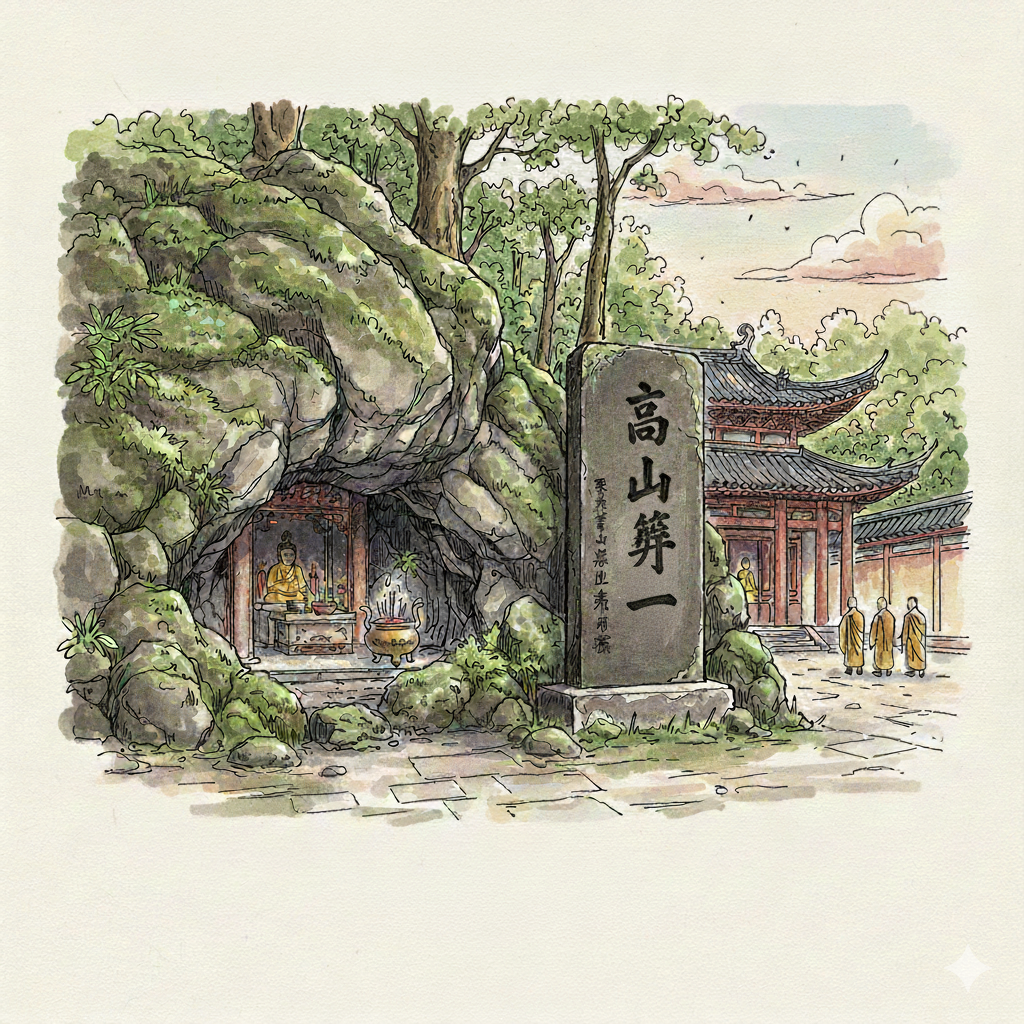
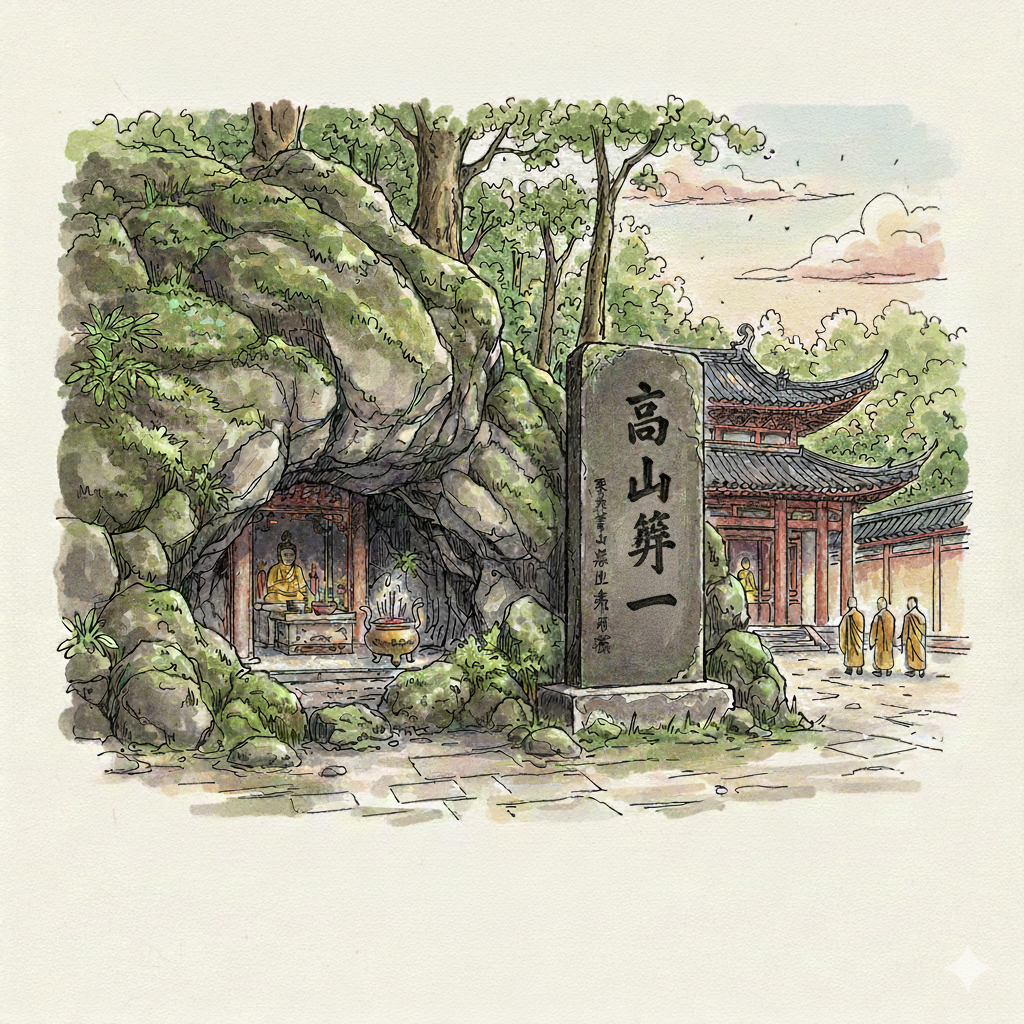
This narrative fundamentally challenges the perception of the region as a peripheral backwater. Instead, it positions Tuen Mun as the very wellspring of Hong Kong's Buddhist faith. The hidden gem of this story isn't just the monastery itself, but the place where it all began: the Cup Ferry Rock (Bēidù Yán, 杯渡岩), the monk’s legendary meditation cave. Near this sacred spot is a stone carving bearing four powerful characters: "High Mountain First" (Gāoshān Dìyī, 高山第一). Incredibly, this calligraphy is attributed to Han Yu, a towering figure of the Tang Dynasty—a famous Confucian scholar and a known, vocal critic of Buddhism. The presence of his words at a Buddhist holy site creates a profound cultural paradox, suggesting that on the empire's frontier, rigid ideologies could soften, allowing for a surprising degree of tolerance and cultural fusion. This fusion of identities cemented the mountain's status as a sacred landmark, so much so that by the Qing Dynasty, the "Traces of the Buidu Immortal" (Bēidù Xiānzōng, 杯渡仙蹤) were celebrated as one of the famed "Eight Great Sights of the Region."
From this spiritual gateway, Tuen Mun's identity would evolve, transforming from a sanctuary for faith into a fortress for an empire.
The Emperor's Southern Shield: Tuen Mun as a Maritime Silk Road Fortress
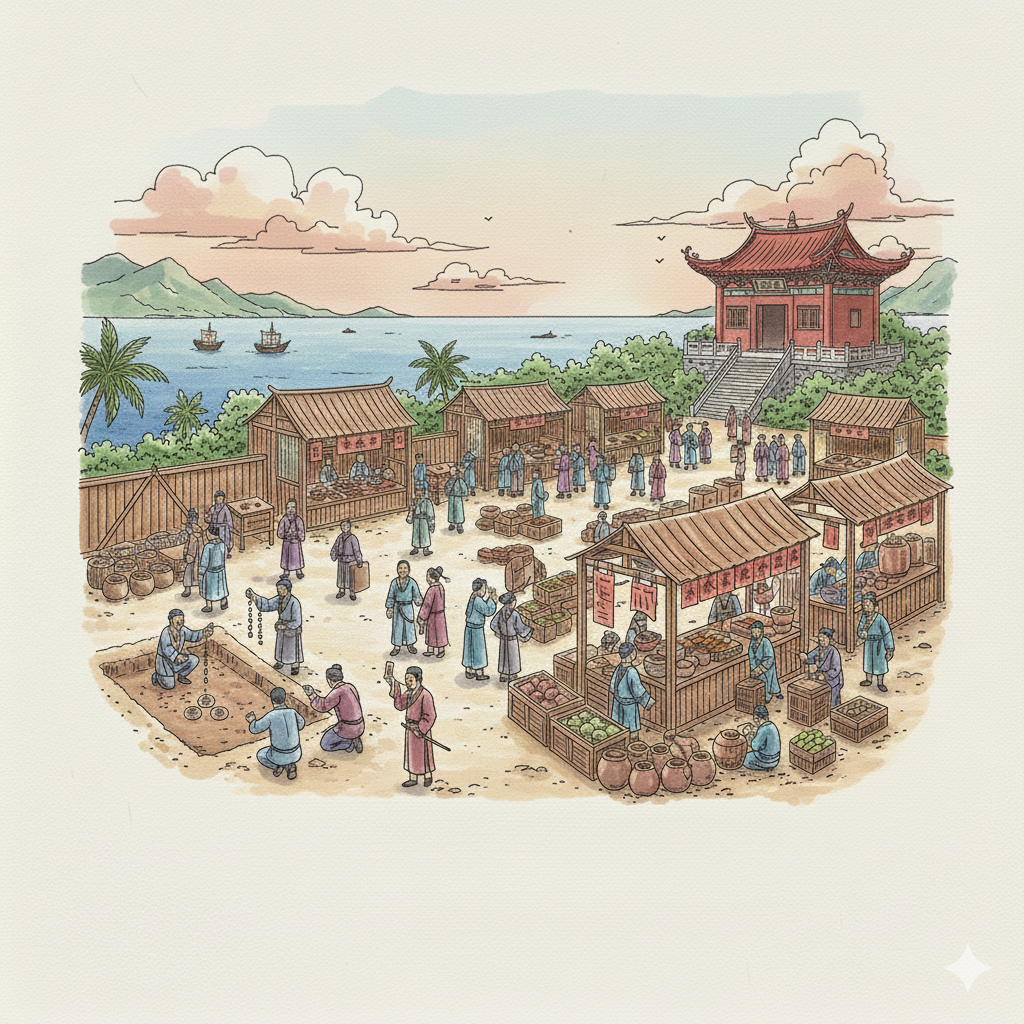
During the Tang and Song dynasties (8th-12th centuries), Tuen Mun’s role shifted from spiritual anchor to imperial stronghold. It was no longer just a remote mountain; it became a critical piece of state infrastructure—the first checkpoint and defensive bastion for all foreign ships sailing the Maritime Silk Road to the great port of Guangzhou. Its very name, which translates to "garrison gate," originates from this period, when imperial troops were stationed here to protect the empire's southern flank.
Historical records and archaeological finds paint a vivid picture of a bustling, fortified town. Discoveries of Tang dynasty kilns and ceramics at Lung Kwu Tan (Lónggǔtān, 龍鼓灘) prove it was not just a military outpost but also a production and supply center for the vast trade network. Its importance was even captured in the poetry of Han Yu, who described its dramatic meeting of "high clouds and surging waves," while Song dynasty officials like Jiang Zhiqi took the time to write official records of the area. Ancient chroniclers described its unique geography—protected on three sides by mountains—as a "natural-born pass" (yǎnrú tiānshēng guān'ài, 俨如天生關隘), a perfect defensible harbor that made it an irreplaceable node in China's maritime defenses.
This history dramatically reshapes our understanding of the region's economic past, proving its global connections were forged centuries before the British era. The hidden gem here is not a single object but a concept: the historical coordinates of the Lung Kwu Tan coastline and the now-vanished Tuen Mun Old Market (Túnmén Jiùxū, 屯門舊墟). Standing on these modern shores, you are standing where Persian, Indian, and Southeast Asian vessels once anchored, where merchants registered their cargo before being granted entry into China. It was here, not in Victoria Harbour, that the region's story as a global trading hub truly began.
As the grand scale of imperial power waned, the mantle of defense would fall to the communities who called this gateway home, demanding a new kind of fortress.
The Clan's Brick Fortress: A Story of Survival and Secret Nobility
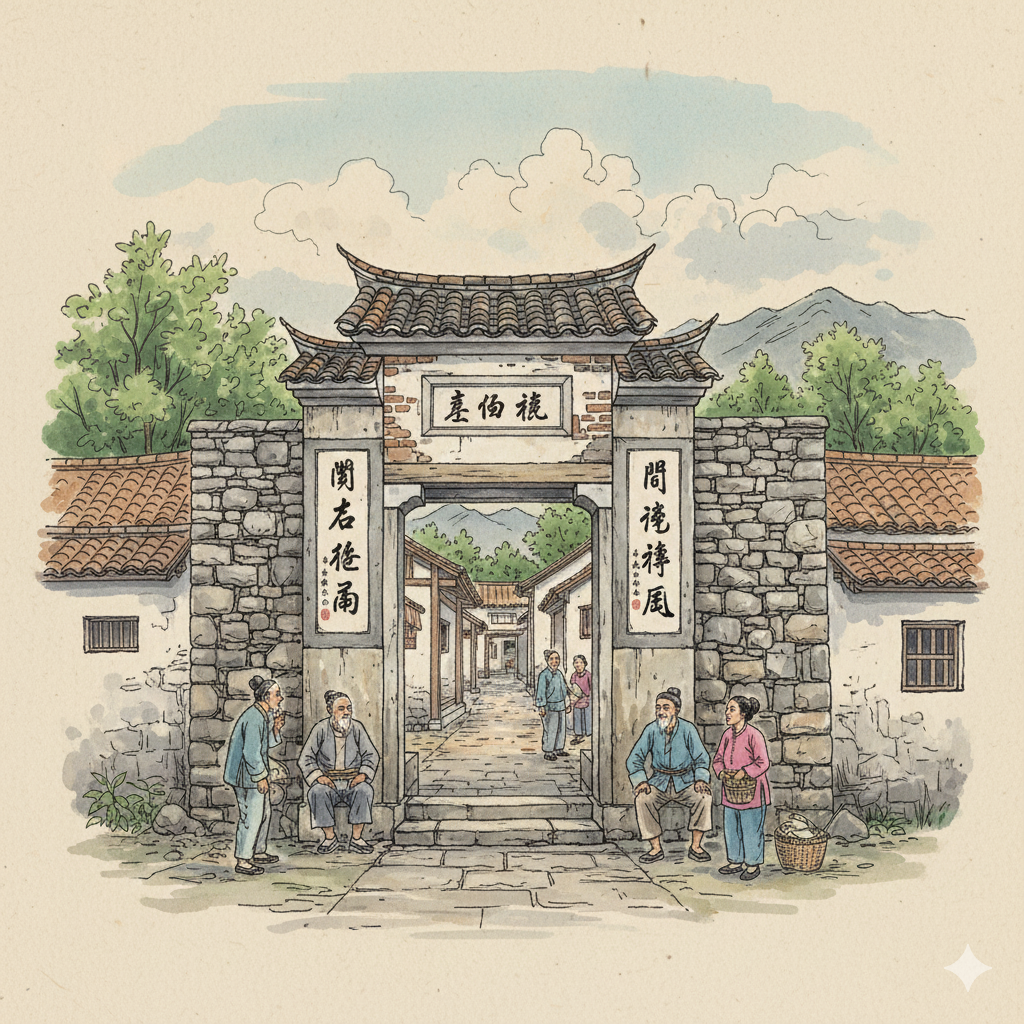
The walled villages (wéicūn, 圍村) of the New Territories are more than just quaint historical settlements; they are sophisticated fortresses born from an era of intense conflict. During the Qing Dynasty, violent "local-Hakka armed conflicts" (tǔ-kè xièdòu, 土客械鬥) over land and resources turned the frontier into a volatile landscape. In response, local clans embraced a philosophy of extreme self-reliance, constructing fortified villages that were marvels of defensive architecture.
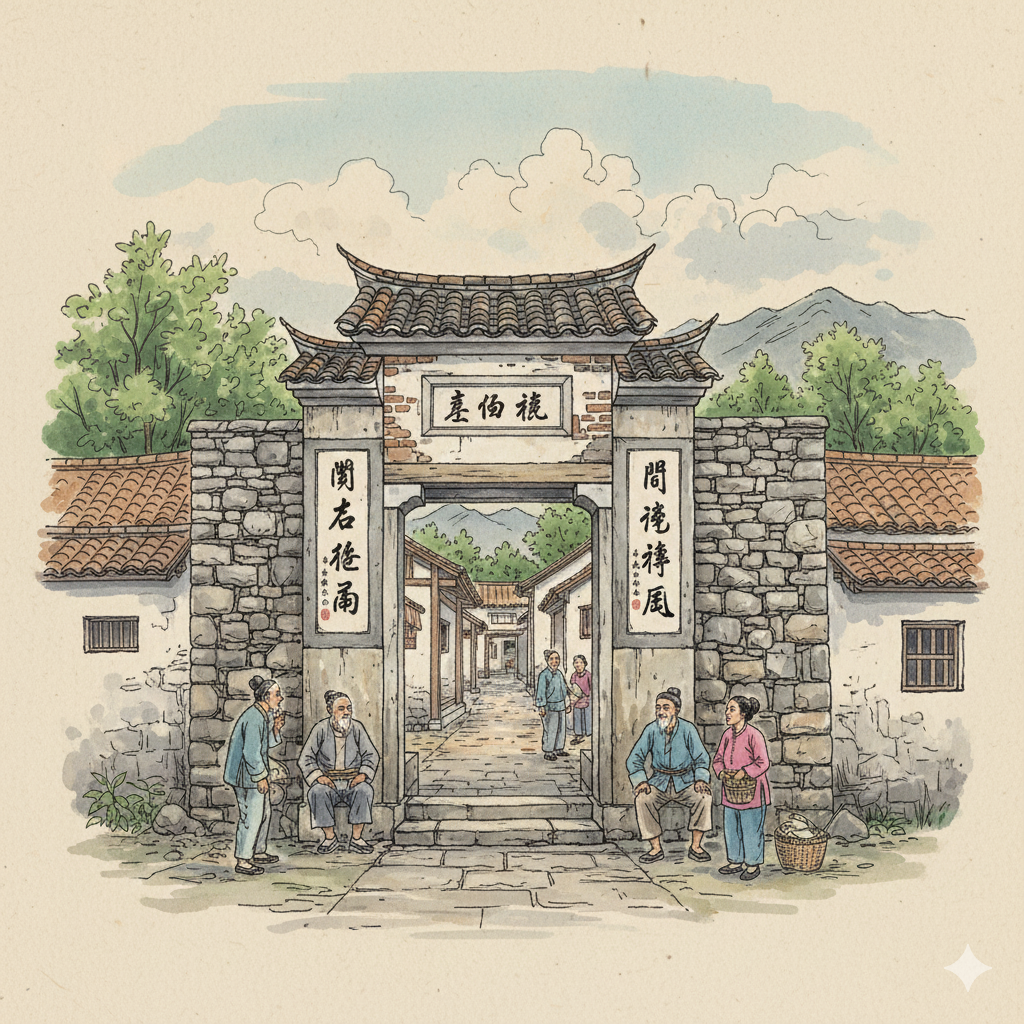
Villages like Lo Wai (Lǎo Wéi, 老圍), the oldest in the area, were built for survival. Their features tell a story of constant vigilance: towering brick walls four to five stories high, tiny windows to repel attackers, fortified corner watchtowers (pàolóu, 炮樓), and internal wells to ensure a water supply during a siege. The couplet at its entrance—"The high gate welcomes auspicious energy; the old wall preserves pure customs" (méngāo yíng zǐqì, wéilǎo dé chúnfēng, 門高迎紫氣圍老得淳風)—speaks to a deep pride in its history. This narrative deepens with the To Clan (Táo Shì Zōngzú, 陶氏宗族) of Tsz Tin Tsuen (Tún Zǐ Wéi, 屯子圍), whose story elevates these structures beyond mere defense.
This history transforms the walled villages from simple agricultural communities into symbols of sophisticated survival strategy and profound cultural preservation. The ultimate hidden gem lies inscribed for all to see, yet its meaning is easily missed. It is the ancestral couplet hanging outside the To Clan's ancestral hall:
八州世澤,五柳家聲
(Legacy of Eight Prefectures, Family Voice of Five Willows)
This elegant verse is not mere decoration; it is a stunning declaration of secret nobility, a claim of direct lineage to two towering figures in Chinese history: the powerful Jin Dynasty governor Tao Kan, who once oversaw eight prefectures, and his great-grandson, the legendary poet Tao Yuanming, known as the "Gentleman of the Five Willows." This couplet reveals that the people within these walls were not isolated peasants but carriers of a proud and ancient cultural legacy.
This deep-rooted instinct for defense, honed over centuries of clan conflict, would soon be called upon to serve a much larger cause: the birth of a new nation.
The Revolution's Secret Arsenal: The Forgotten Front Line of 1911
At the dawn of the 20th century, Tuen Mun's quiet hills and remote coastline played an unexpected and critical role in modern Chinese history. It became a secret staging ground for the Xinhai Revolution that overthrew the Qing dynasty, revealing that Hong Kong was not a passive observer but an active participant in the creation of modern China.
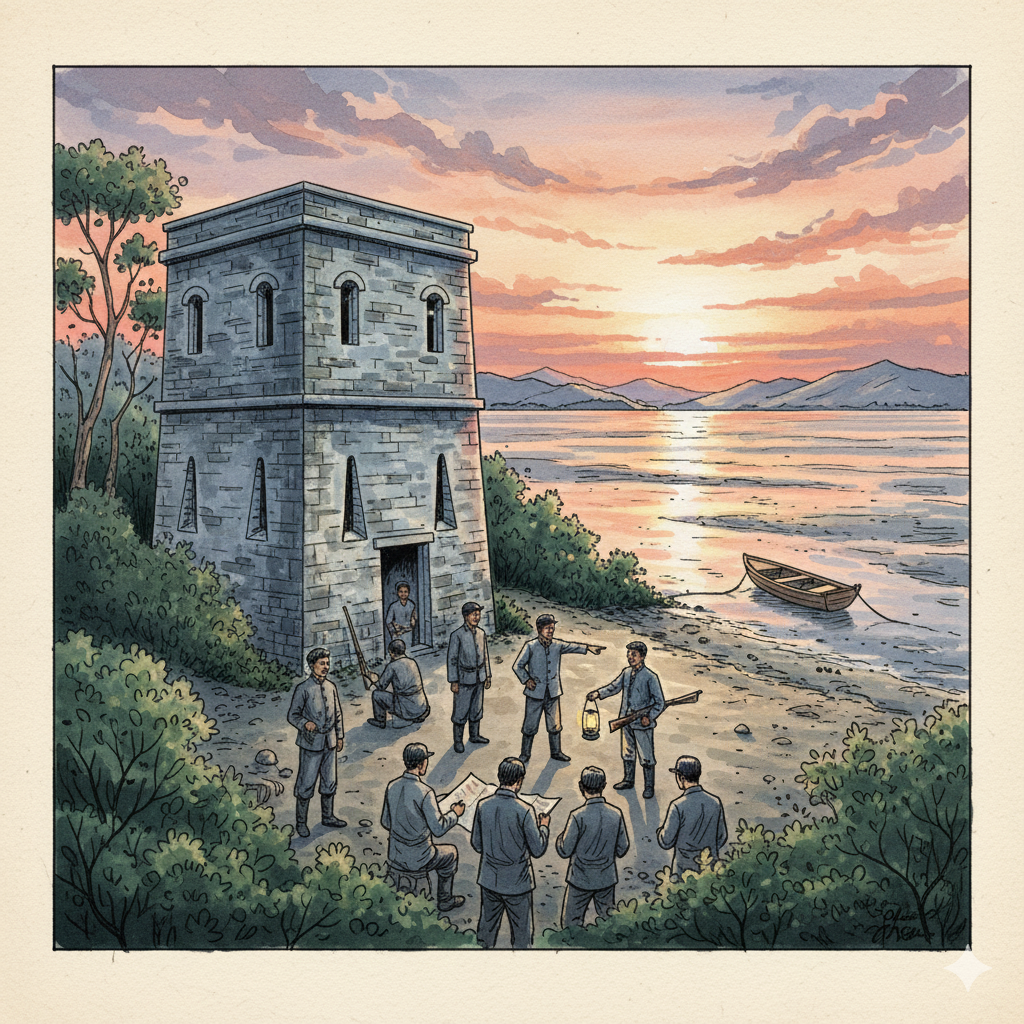
Led by followers of Sun Yat-sen and funded by the influential merchant Li Jidang (Lǐ Jìtáng, 李紀堂), revolutionaries established the "Tsing Shan Farm" (Qīngshān Nóngchǎng, 青山農場) as a clandestine base. Disguised as an agricultural enterprise, its true purpose was to store weapons, conduct military drills, and provide refuge for revolutionaries. As the movement grew, another key figure, Deng Yin-nan, established a second, even more secure base to act as a backup and escape route should the first be discovered.
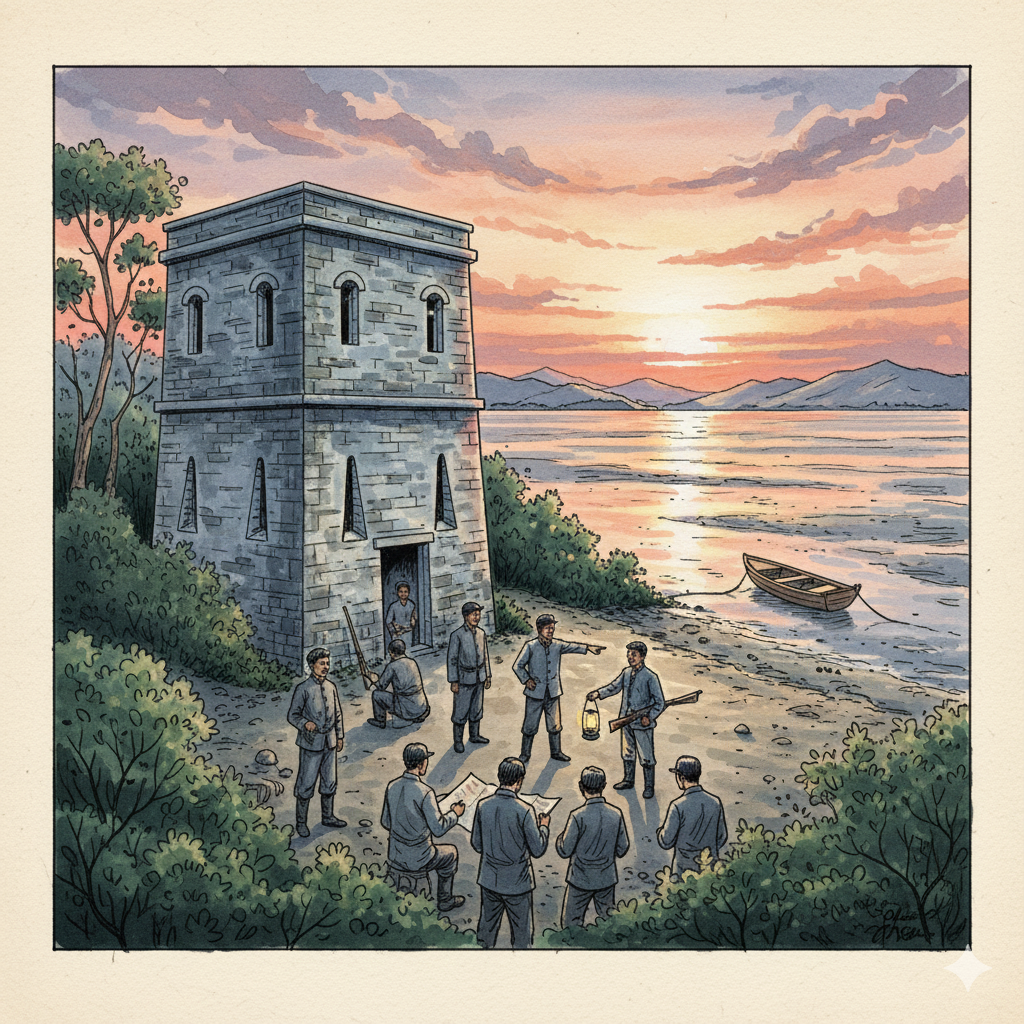
The irony is profound: one of Hong Kong's most peaceful and remote corners was, for a time, a nerve center for a national revolution. The undeniable hidden gem of this story is that second base: the Ha Pak Nai Bunker (Hà Bǎiní Diāobǎo, 下白泥碉堡), now a declared historical monument. Its design is a masterpiece of tactical ingenuity. Built of thick brick, the two-story structure features firing ports and cone-shaped windows for broad defensive sightlines. Its location was its greatest asset—tucked away on a remote stretch of coast overlooking Deep Bay, surrounded by mangrove forests and mudflats, it was perfect for concealment and, if necessary, escape by sea.
For the modern visitor, this quiet structure completely rewrites the landscape's story, transforming a picturesque sunset view into a portrait of revolutionary fervor and strategic daring. The struggle for the nation's future would soon evolve from an internal fight to a desperate defense against foreign invasion.
The Guerillas' Coastline: Echoes of WWII Resistance on the Beach
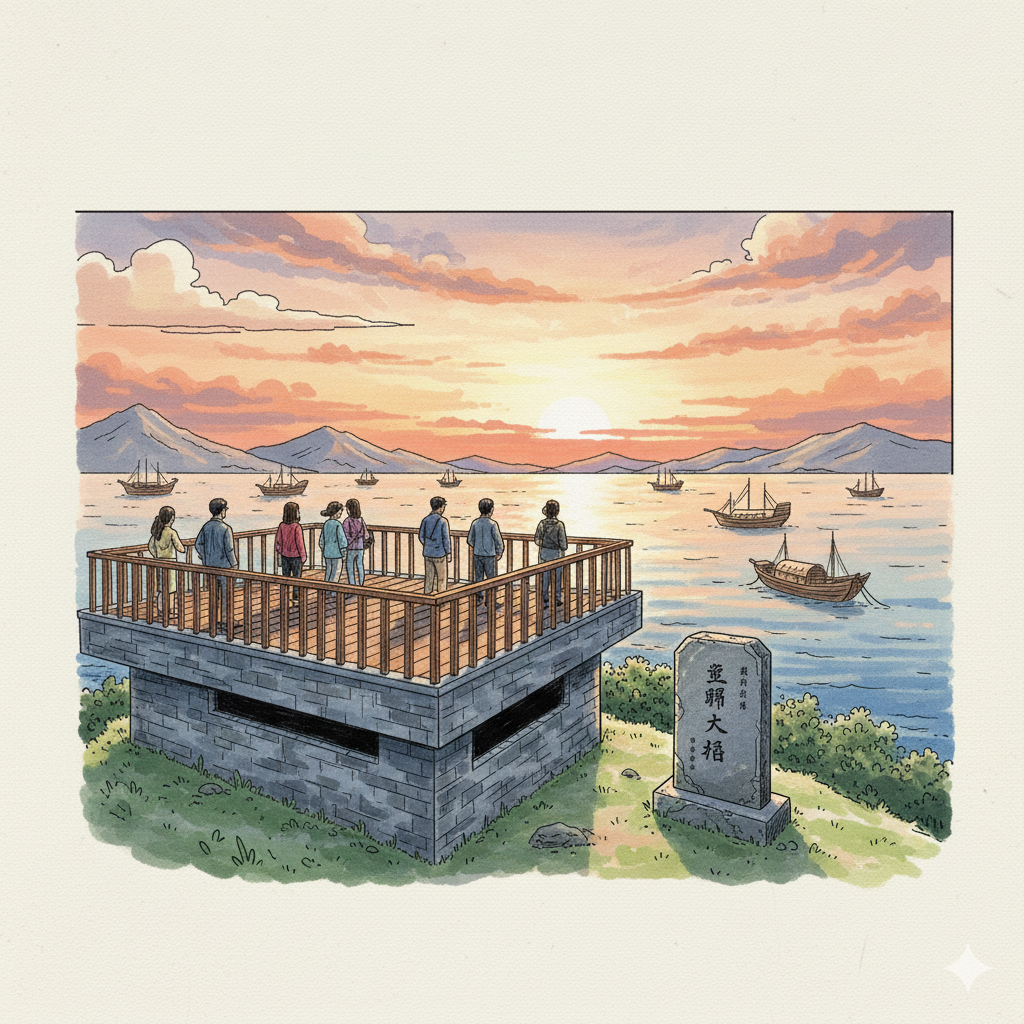
Tuen Mun's long military history found its 20th-century echo during the darkest days of World War II. During the Japanese occupation of Hong Kong, the coastline at Lung Kwu Tan became a forward base for the "Hong Kong and Kowloon Independence Brigade" (Gǎng-Jiǔ Dàduì, 港九大隊), the local guerilla force that mounted a fierce resistance. The patriotic spirit of the local villagers, whose ancestors had defended this land for centuries, burned brightly once again.
These resistance fighters used the familiar terrain for their operations, relying on the support of the local community. The grand narrative of this struggle is grounded in personal sacrifice. Among the many who fought was a local villager named Liu Fa-tzai (Liú Fāzǎi, 劉發仔), who was killed in action and is now officially recognized as one of the brigade's 115 martyrs. His story transforms the history of the resistance from an abstract conflict into a deeply human tale of courage and loss.
This final chapter doesn't just bookend Tuen Mun's history; it reveals its core, unbroken identity. The resistance fighters on the coast were unknowingly echoing the mission of the Tang dynasty garrison stationed there over a millennium earlier, proving that Tuen Mun's role as a defensive 'gateway' for the nation is its most enduring legacy. The hidden gem here is a modern one: the lookout post and monument at Lung Kwu Tan, built to honor these resistance heroes. From this vantage point, a visitor can survey the entire coastal battlefield—the beaches, the sea, and the outlying islands—connecting the physical landscape of today directly with its heroic past. These five distinct gateways—of faith, empire, clan, revolution, and resistance—ultimately merge into one profound historical narrative.
Conclusion: Re-Reading the Map of Hong Kong
Taken together, these five stories prove that the dominant narrative of Hong Kong—one centered almost exclusively on Victoria Harbour and the colonial era—is fundamentally incomplete. The history of Tuen Mun reveals that what we often dismiss as the periphery was, in fact, a starting point. It served as a multi-layered "gateway" across a dozen centuries.
It was a gateway for faith, where Buddhism first entered the region. It was a gateway for empire, the fortified door through which the riches of the world flowed. It was a gateway for survival, where clans built fortresses of brick and resilience. It was a gateway for revolution, a secret front line in the fight for a new China. And it was a gateway for resistance, where local heroes defended their home against invasion.
The story of Tái Mùn challenges us to look beyond the familiar and reconsider the very foundations of Hong Kong's identity. It reminds us that history is not just in the monuments we are shown, but in the landscapes we overlook.
If a place we thought we knew can hold so many hidden worlds, what other secret histories lie waiting to be discovered right under our feet?
Work Cited:
【港文化港故事】訪尋青山寺參詳杯渡誌- 香港文匯報, accessed October 25, 2025
青山寺歷史起源accessed October 25, 2025, accessed October 25, 2025
屯門近年考古發現印證香港六千年的文化發展, accessed October 25, 2025
香港佛教發源地:青山寺的歷史與文化價值 - 九谷燒, accessed October 25, 2025, 元朗下白泥碉堡, accessed October 25, 2025
老圍 「五圍」中最早建立村落 - 《我家》Homemory, accessed October 25, 2025
青山寺位於屯門,又名青山禪院,是香港三大古寺之一,據考證應為香港佛教發源 - EdUHK, accessed October 25, 2025
香港軍事遺址- Home - 香港海防博物館, accessed October 25, 2025
屯門舊墟- 維基百科,自由的百科全書, accessed October 25, 2025
屯門舊墟- 維基百科,自由的百科全書, accessed October 25, 2025
香港圍村 - 維基百科, accessed October 25, 2025
屯門圍村走, accessed October 25, 2025, 屯門陶族, accessed October 25, 2025
下白泥碉堡 - 維基百科, accessed October 25, 2025
附件A 歷史建築評估位於新界元朗下白泥55 號的碉堡位於元朗下白, accessed October 25, 2025