(ENG) Beyond the Steel: 5 Stories That Reveal the Unexpected Soul of Muroran, Hokkaido
Often overlooked, Muroran reveals its true beauty not to the casual visitor, but to those willing to listen to its stories. Its identity is not one of polished, manufactured charm, but of a complex and authentic character forged from conflict, misunderstanding, and adaptation.
Listen attentively to the historical stories told in detail
The City of Contradictions
Industrial port cities have a reputation, a certain gray grit we conjure in our minds. We picture utilitarian landscapes of concrete and steel, skylines of smokestacks silhouetted against a perpetual overcast sky—places of function, not poetry. At first glance, Muroran, a port on the southern coast of Hokkaido, seems to play the part. It is a city forged in coal and iron, its identity inseparable from the sprawling shipyards that line its bay. Yet to dismiss it as just another cog in the machine is to miss the profound narrative woven into its very fabric—a story built on what could be called a "philosophy of conflict," where the sublime power of heavy industry exists in a constant, beautiful dialogue with the raw, untamed force of nature.
What if a city's true character wasn't found in its primary industry, but in the surprising stories hidden in its landscape, its ancient legends, and even its local snacks?
This article uncovers five such stories that reveal the hidden soul of Muroran. They are tales of cultural misinterpretation, of ancient gods finding new life in modern machinery, of sacred spirituality nestled against industrial might, of failure breeding strength, and of history served on a simple wooden skewer. Together, they transform Muroran from a forgotten industrial town into a place of unexpected wonder and profound depth.
1. The World's Edge is a Warning: The Misunderstood Name of Cape Chikyu
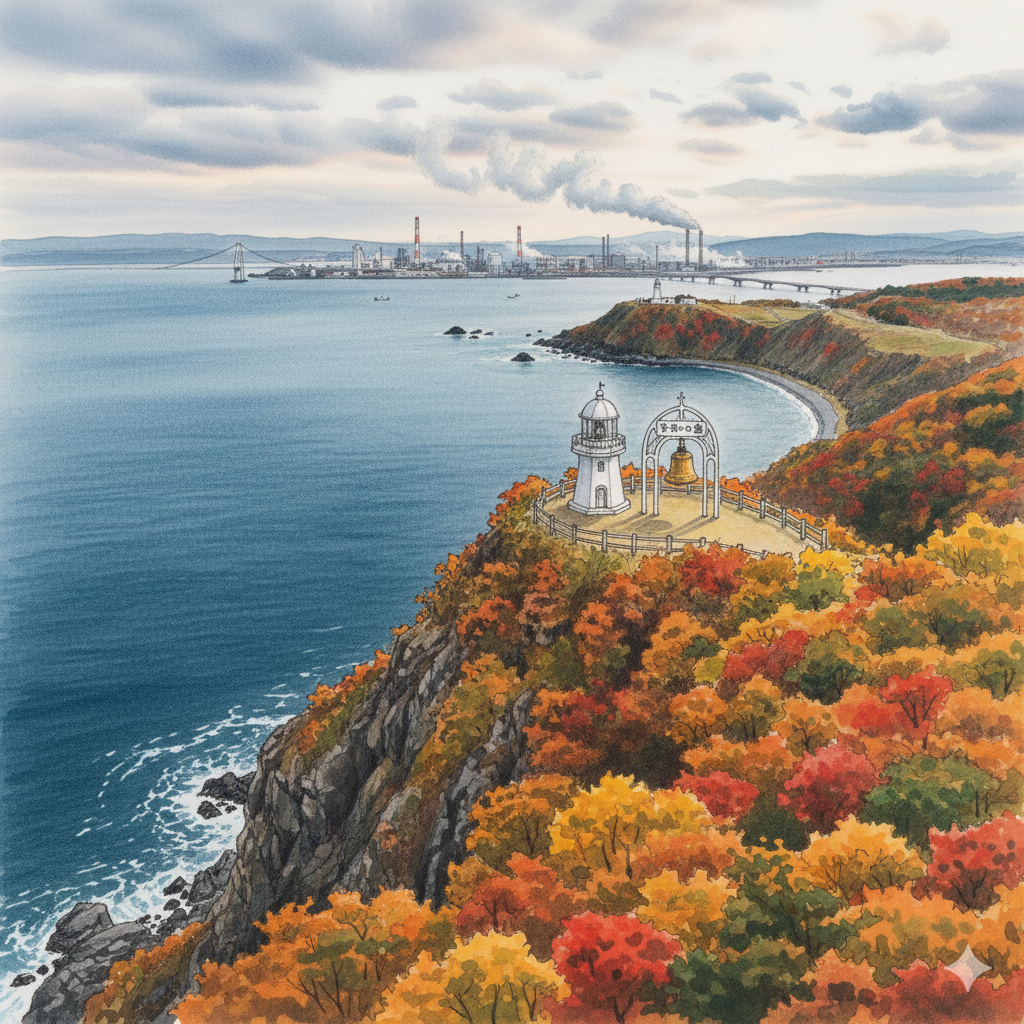
Iconic landmarks are powerful things; they often become the single, defining image of a destination. For Muroran, that landmark is Cape Chikyu, a breathtaking viewpoint perched atop a 131-meter cliff. It is celebrated for its panoramic vista of the Pacific Ocean, where the horizon curves so distinctly that visitors feel they are witnessing the roundness of the Earth. Crowning this precipice is the white, octagonal Chikyu Misaki Lighthouse, a beacon of human order built in 1920, standing sentinel over the wild expanse. Here, people ring the "Bell of Happiness," feeling a grand, romantic connection to the planet.
But the cape’s most captivating story lies not in the view, but in its name. The popular image is built on a linguistic misunderstanding. The name "Chikyu" (地球), which means "Earth" in Japanese, is a phonetic approximation of the original name given by the indigenous Ainu people: Ci-ke-p, which simply means "steep cliff."
This shift from Ci-ke-p to Chikyu represents a profound cultural transformation. For the Ainu, the name was a practical, respectful warning—a descriptor born from a deep understanding of a dangerous landform. It was grounded in survival and reverence for the immediate environment. The later Japanese name, however, abstracts this reality into a philosophical concept, shifting the focus from the tangible danger below to the romantic idea of the planet as a whole. The lighthouse itself becomes a perfect symbol of this duality: a man-made structure of logic and safety standing atop a sacred Ainu cliff named for its raw peril.
The cape's Ainu name, Ci-ke-p, was a practical warning, not a romantic observation.
This story of an ancient name hiding beneath a modern one serves as a gateway to the deeper mythological currents that flow just beneath the city's surface.
2. The Octopus God in the Machine: How an Ancient Myth Embodies Modern Industry
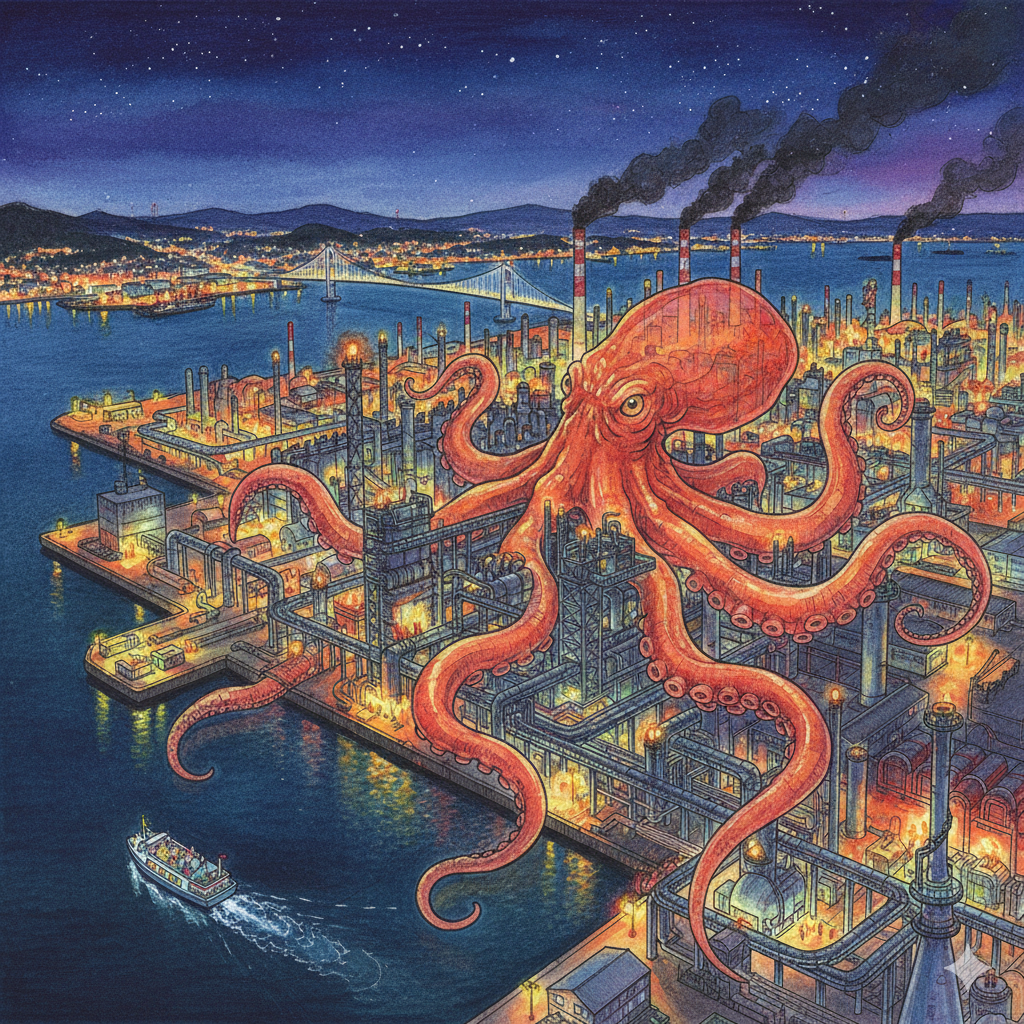
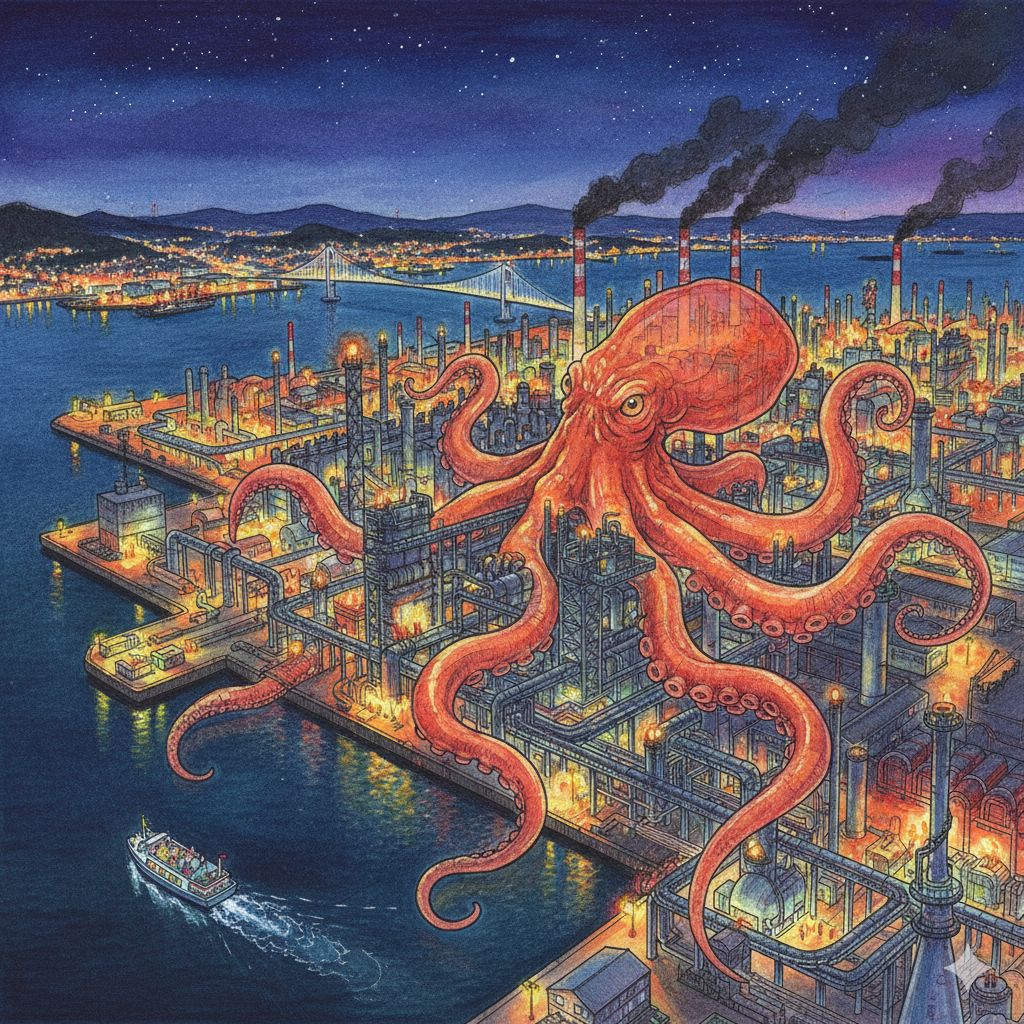
Ancient myths often serve as potent metaphors for the enduring powers that shape a region. In Muroran, the waters of Uchiura Bay are home to such a legend: Akkorokamui, a colossal octopus god, or kamuy, so immense it was said to cover a hectare when its tentacles were spread.
The legend states that Akkorokamui was not always of the sea. It began as a monstrous red spider that terrorized the mountains. When the people prayed for deliverance, the sea god dragged the spider into the bay, transforming it into a massive octopus that became ruler of the deep. With the ability to regenerate its limbs, Akkorokamui also became a deity of healing. The name itself reinforces this image: in the Ainu language, it is at-kor-kamuy, "the god possessing strings/strips."
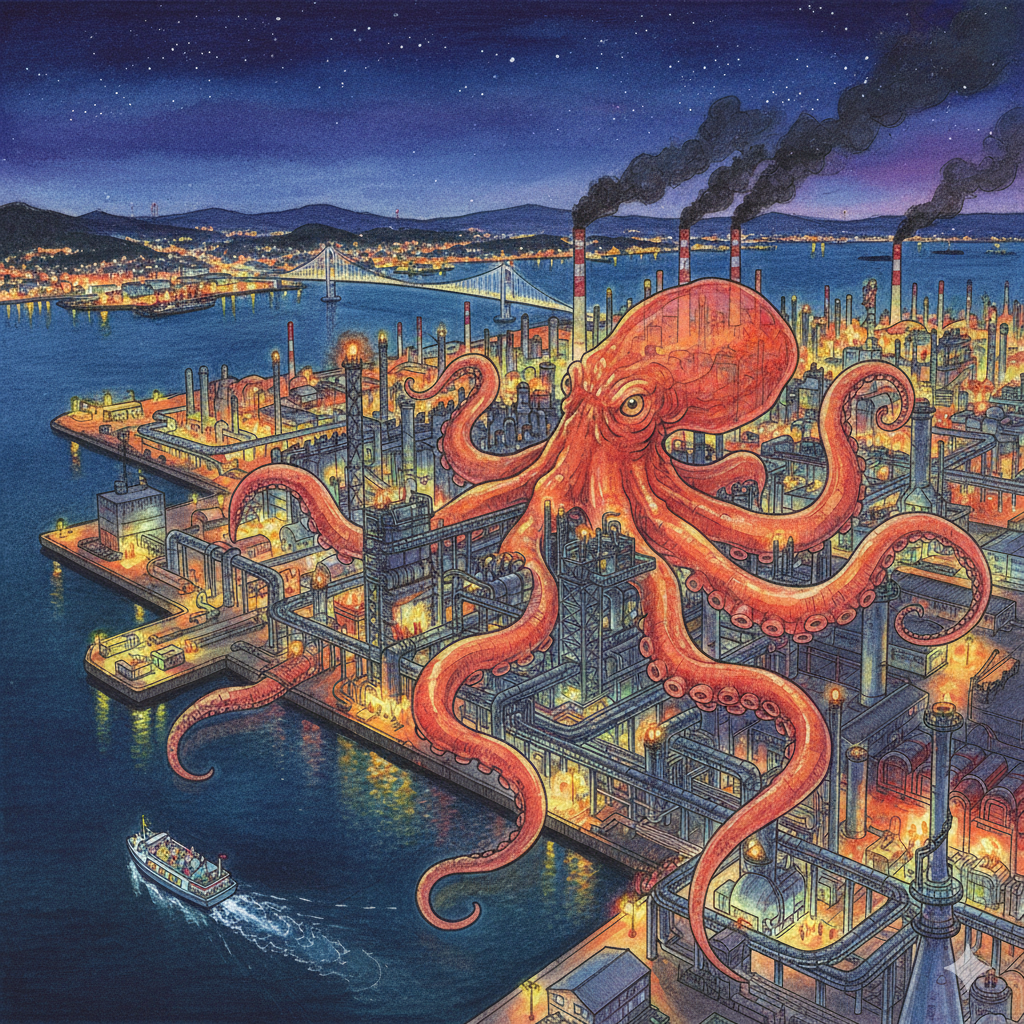
This ancient tale seems worlds away from Muroran's modern identity. But stand on the Mt. Mitsuishi (Sokuryozan) observation deck or the Hakucho Bridge at night and look upon the port, and the myth comes roaring back to life. The industrial complex—a sprawling, tangled network of pipes, cranes, and mills—glows with an otherworldly light. Its structures stretch out like metallic limbs, a vast organism of human creation. The visual parallel is undeniable: the modern port is the perfect manifestation of the ancient, many-tentacled octopus god.
The tangled, sprawling network of the steel factories at night perfectly mirrors the grasping tentacles of the ancient octopus god, Akkorokamui.
The myth also provides a perfect narrative for the city’s own history.
The sea god dragging a land-based destroyer into the ocean and transforming it into a marine power is a perfect parallel for Muroran itself: a city that transformed its agriculturally-poor land into a titan of sea-based industry.
This potent blend of myth and machine is part of a larger duality that defines the entire city, a constant conversation between human creation and the natural world.
3. The Steelworks and the Sacred Cliffs: Muroran's Philosophy of Opposites
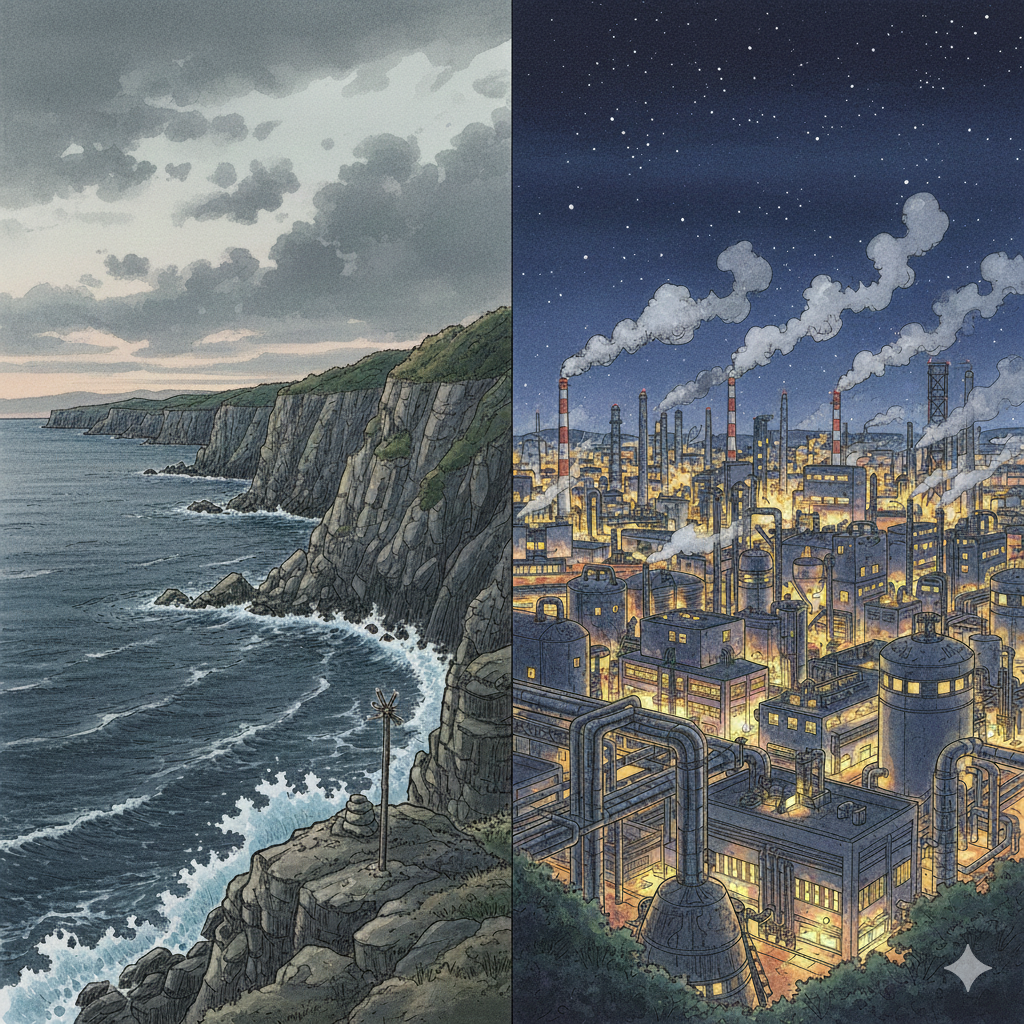
Most cities strive for a singular, harmonious identity. Muroran, however, derives its unique character from a dramatic tension between two opposing forces: heavy industry and pristine nature. It doesn’t hide one behind the other; it presents them as equals, allowing their conflict to become a form of art.
On one side is the "sublime of industry." Muroran is unapologetically a "steel city," home to massive factories that create a breathtaking spectacle at night. From viewpoints across the bay, the industrial zone glitters like a "jewel box," a testament to human ingenuity and technological might.
On the other side, nature answers with its own raw power. A 14-kilometer coastline of sheer cliffs stands against the Pacific, a fortress of ancient rock relentlessly carved and battered by the cold, northern waves—a testament to forces far older than steel. This is not a generic coastline; it has a name and a story. Places like Tokkarisho, whose Ainu name means "seal rock," are a reminder of the deep ecological history embedded in the landscape.
Instead of a contradiction, Muroran presents these two forces as a dialogue. The city treats its industry not as a scar but as another magnificent landscape. What deepens this connection further is that this raw nature is also profoundly spiritual.
Many of the most beautiful natural cliffs, such as Kinbyobu, are also designated Pirka noka—sacred Ainu sites for praying to the gods (kamuy), placing ancient spirituality directly beside modern industry.
This fusion—where sacred Ainu prayer sites overlook a sprawling industrial port—is the very essence of Muroran’s soul, a landscape shaped by both ancient gods and the pioneers forced to tame it.
4. Forged from Failure: The Settlers Who Couldn't Farm and Built a Steel City Instead
A city's foundational story is often one of heroic success. Muroran's story, counter-intuitively, is rooted in failure and adaptation. In the Meiji era, the government sent farmer-soldiers known as Tondenhei to settle and defend Hokkaido. These pioneers, many of them former samurai, arrived with the dream of creating a prosperous agricultural community.
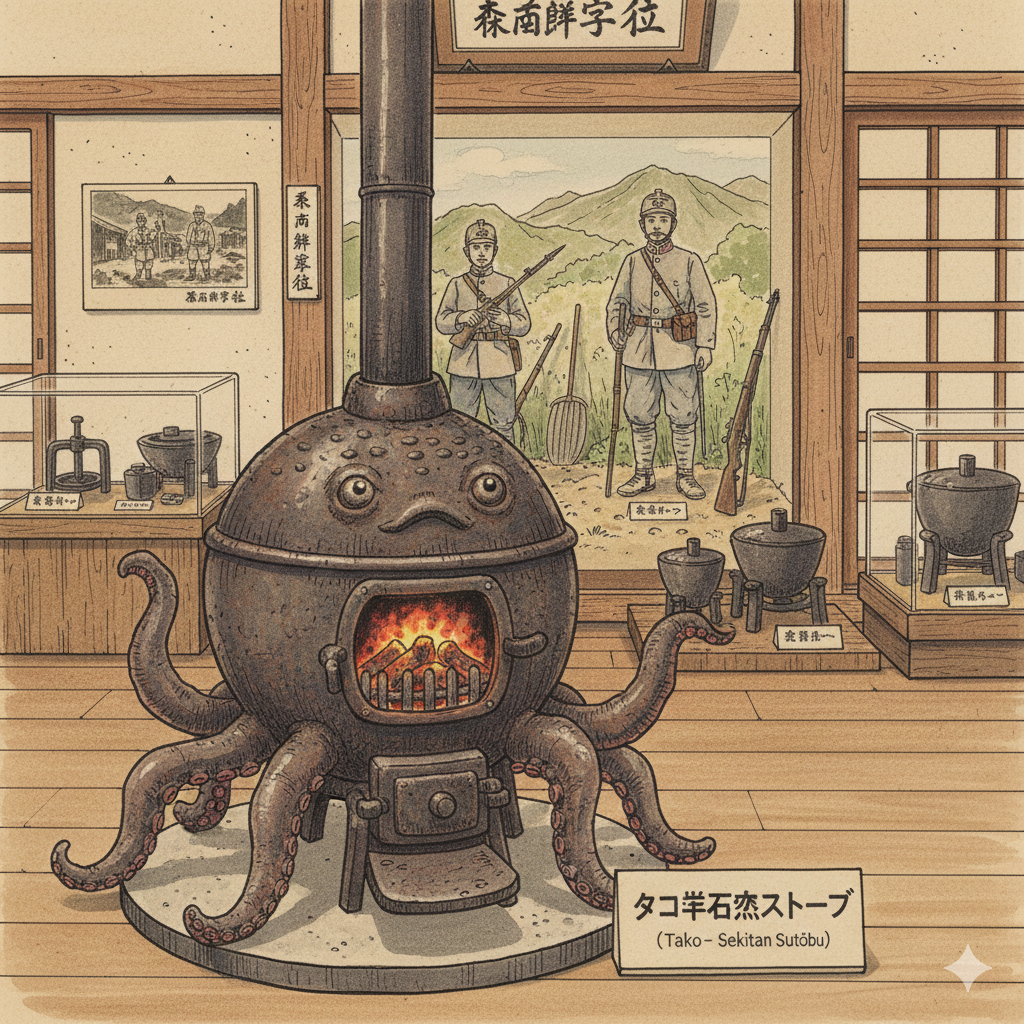
In Muroran, however, that dream met the hard reality of the land. The settlers discovered that the rugged, mountainous terrain was entirely unsuitable for large-scale farming. Their mission was a structural failure. But this collapse was not an end; it was the catalyst that forged Muroran's true identity. Faced with starvation, the settlers pivoted to manufacturing, starting by casting pots and pans and laying the groundwork for a "city of iron." This story of resilience is best understood at the Muroran Folklore Museum (Tontenkan), where artifacts from Tondenhei uniforms to the crude tools of early industry tell a tangible story of adaptation. The city’s greatest strength grew directly from its most significant weakness.
Muroran became a great industrial city not by choice, but because its pioneers were failed farmers, forced by the unforgiving land to find another way to survive.
The spirit of these pioneers lives on, not just in the factories they built, but in the unique cuisine they created to fuel their labor.
5. History on a Skewer: The Uniquely Working-Class Story of Muroran Yakitori
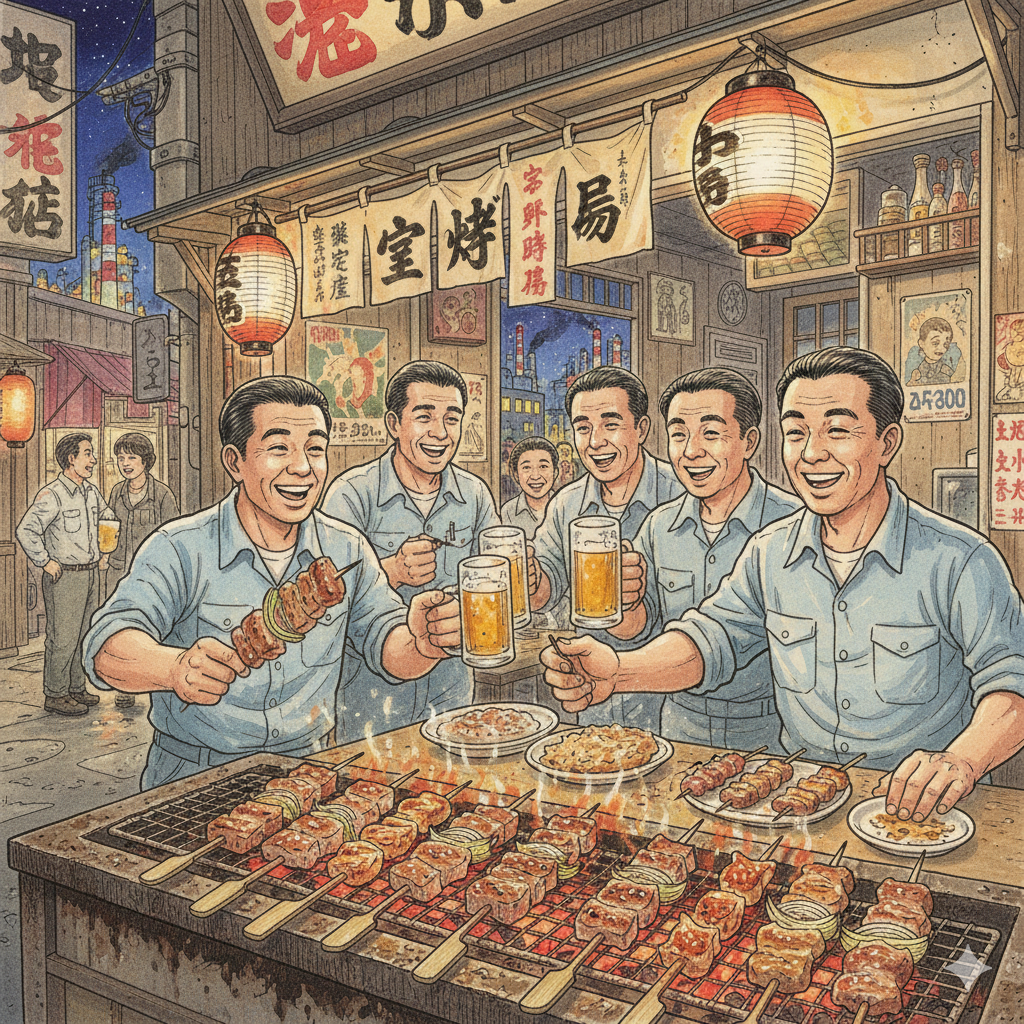
Regional cuisine often serves as a delicious historical document, and in Muroran, the city’s most beloved soul food—Muroran Yakitori—is a perfect example. Though "yakitori" means "grilled chicken," in Muroran the dish is defined by three ingredients: pork instead of chicken, onions instead of leeks, and a dab of hot mustard. This combination, born in the food stalls of the Wanishi-cho district, is not a random culinary quirk; it is a direct reflection of the city's history.
- Pork: During Japan's industrialization, the government promoted pig farming to produce leather for military boots. A byproduct was a surplus of cheap pork, which became the affordable, high-energy meat of choice for the city's blue-collar "iron men."
- Onions: Hokkaido is one of Japan’s largest onion producers. For the working class, locally grown onions were a cheaper, more durable, and more available alternative to the traditional leeks used elsewhere.
Every bite of this simple dish is a taste of the city's history, shaped by national military policy, local agricultural economics, and the practical needs of an industrial population. The most surprising story it tells is how global forces can end up on a local dinner plate.
The pork on the skewers is a direct culinary legacy of the military's demand for leather boots during Japan's industrialization.
From the grand sweep of its landscapes to a simple skewer of meat, Muroran’s identity is a rich tapestry of such fascinating, interwoven stories.
Conclusion: The Poetry of a Forgotten Port
Often overlooked, Muroran reveals its true beauty not to the casual visitor, but to those willing to listen to its stories. Its identity is not one of polished, manufactured charm, but of a complex and authentic character forged from conflict, misunderstanding, and adaptation.
Here, the Ainu name for a cliff becomes a meditation on the Earth. The myth of an octopus god finds its modern form in the glowing tentacles of an industrial port. Sacred prayer sites share a horizon with steel mills. A city’s greatest triumph is born from agricultural failure, and a nation's military ambitions are captured in the taste of a working-class meal. Muroran challenges us to look beyond surface appearances—to see the poetry in the machine, the philosophy in a place name, and the history in a humble dish.
It leaves us with a lingering question: How many other places have we overlooked, simply because their stories are written not in polished brochures, but in the honest language of steel, stone, and survival?
Works cited:
1. Muroran - Wikipedia, accessed October 4, 2025, https://en.wikipedia.org/wiki/Muroran
2. Muroran: The town that Time forgot - Spike Japan - WordPress.com, accessed October 4, 2025, https://spikejapan.wordpress.com/spike-hokkaido-2/muroran-the-town-that-time-forgot/
3. Muroran: A "steel city" from the Meiji era – one that never sleeps ..., accessed October 4, 2025, https://kai-hokkaido.com/archives/en/town_vol34_profile/
4. Muroran: Awe-inspiring urban and natural views, accessed October 4, 2025, https://hokkaido-treasure.com/column/073/
5. Muroran Travel Guide: 20 Top Things to Do in Muroran, Japan - Nomadic Samuel, accessed October 4, 2025, https://nomadicsamuel.com/city-guides/muroran-travel-guide
6. The Earth Is Round At Cape Chikyu - Hokkaido - Japan Travel, accessed October 4, 2025, https://en.japantravel.com/hokkaido/the-earth-is-round-at-cape-chikyu/11861
7. Cape Chikyu|What to See & Do|HOKKAIDO LOVE! - 北海道, accessed October 4, 2025, https://www.visit-hokkaido.jp/en/spot/detail_10019.html
8. Cape Chikiu - Wikipedia, accessed October 4, 2025, https://en.wikipedia.org/wiki/Cape_Chikiu
9. Akkorokamui - Wikipedia, accessed October 4, 2025, https://en.wikipedia.org/wiki/Akkorokamui
10. Akkorokamui - Yokai.com, accessed October 4, 2025, https://yokai.com/akkorokamui/
11. Akkorokamui - Wikiwand, accessed October 4, 2025, https://www.wikiwand.com/en/articles/Akkorokamui
12. Akkorokamui - Nightbringer.se, accessed October 4, 2025, https://nightbringer.se/myths-and-legends/mythic-akkorokamui/
13. 14 recommended sightseeing spots! Explore “The iron city of Muroran,” famous for its factory night views – skyticket Travel Guide, accessed October 4, 2025, https://skyticket.com/guide/56169
14. Chronology | ABOUT US | NIPPON STEEL, accessed October 4, 2025, https://www.nipponsteel.com/en/company/about/history/
15. Muroran: South Hokkaido's hidden gem between nature and industry - Riviera Tour, accessed October 4, 2025, https://www.rivieratour.cz/en/destinations/mur-muroran
16. Asahikawa's Soldier-Farmers and Ainu, accessed October 4, 2025, https://www.wayfarerdaves.com/3562/
17. Hokkaido's Pioneer Village: Kaitaku no Mura (Historic Village of Hokkaido), accessed October 4, 2025, https://www.wayfarerdaves.com/hokkaidos-pioneer-village-kaitaku-no-mura-historic-village-of-hokkaido/
18. Settling the Frontier, Defending the North (Chapter 9) - The Meiji Restoration, accessed October 4, 2025, https://www.cambridge.org/core/books/meiji-restoration/settling-the-frontier-defending-the-north/AEC718CFB25F77887A62C5B382CA0E11
19. Muroran Folklore Museum (Tontenkan) - Guidoor, accessed October 4, 2025, https://www.guidoor.jp/en/places/3929
20. Yakitori but Pork? The appeal and differences between Muroran yakitori and Bibai yakitori are thoroughly explained! - Domingo, accessed October 4, 2025, https://domingo.ne.jp/en/article/27005
21. Tourism & Special Events|English Page - 室蘭市, accessed October 4, 2025, https://www.city.muroran.lg.jp/content/?content=1988
22. Muroran Yakitori(Muroran Grilled skewers) | Our Regional Cuisines : MAFF, accessed October 4, 2025, https://www.maff.go.jp/e/policies/market/k_ryouri/search_menu/2456/index.html
23. Learning about the Endless Variety of Yakitori Flavors from History - SHUN GATE, accessed October 4, 2025, https://shun-gate.com/en/power/power_86/
24. Kodawari Stories Part 1: Hokkaido Yakitori - brewzakaya, accessed October 4, 2025, https://www.brewzakaya.com/blog/kodawari-stories-part-1-hokkaido-yakitori
25. Lesser-known Muroran, the "city of slopes"|The towns of Hokkaido, accessed October 4, 2025, https://kai-hokkaido.com/archives/en/town_vol34_muroran04/
26. Muroran: A Day Trip - Highlighting Hokkaido, accessed October 4, 2025, https://highlightinghokkaido.home.blog/2022/06/14/muroran-a-day-trip/